Design of the Month · July 2006
-
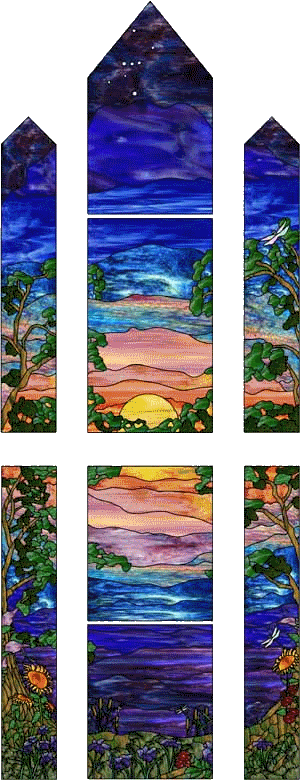
"Memorial Window"
Circa 1890–1914As a father of three, this job had a particular poignancy. A young member of the congregation tragically died in a car accident, and I was approached to design a window to commemorate his life. My client presented me with a list of symbolic inclusions, as well as the sense of what feelings should be conveyed through design. The focus is a setting sun, with the supporting background gradations making the center of the window the brightest, transitioning to night sky at the top and shadows along the edges and bottom.
The particular challenge for his project was that the window cannot be seen in its entirety from the inside of the church. The top portion and bottom portions are in rooms of their own and separated by a floor. Since the primary view of the window will be from outside during the day, the glass selection defaulted to dense opalescents. The chosen glass works well with reflected light, and also has the mixes and shadings I wanted for the sky transitions.
I began this project with a simple concept drawing, which was accepted by the church board. With Glass Eye 2000 I used the initial sketch as a background, and fleshed out the details over a period of weeks. When I had enough to give the clear sense of where I was going I exported the image to Photoshop. Using a shot I took of the church, I composited a scene that gave the members of the board a "real life" visual of how the window would look. Photoshop was useful for making the image more realistic, by softening edges, changing brightness, or even adding colored "shadows" for indoor layouts. This process of "installing" a window or lamp before glass is even cut has been an extremely useful tool for the studio. Many of my clients have a difficult time imagining what a printout or sketch will look like as a window or lamp in their home. This compositing process removes a hurdle of imagination. Not only does it show how the graphic design integrates into the building or room, but with the digitized glass samples they can see if there will be spectral harmony as well.
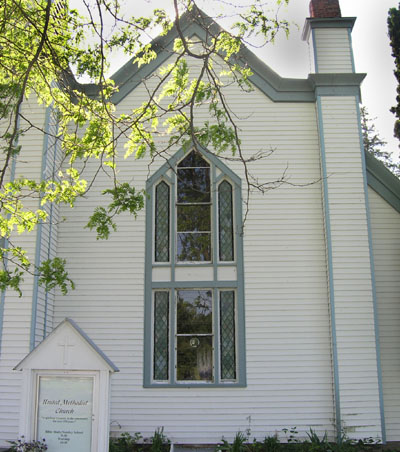
Original photograph of church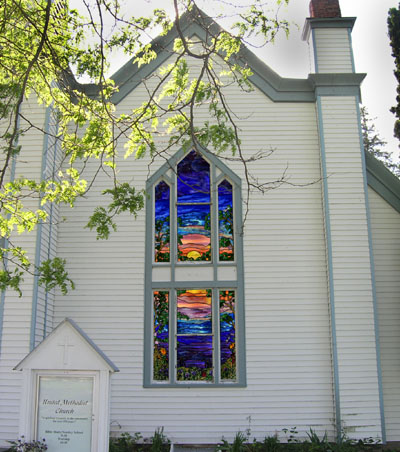
Photo with design overlayThe committee gave the go-ahead and I finalized the design in Glass Eye 2000. Once exported as a high resolution TIFF to a CD, my local copy center made a poster sized color printout that I presented to the board for final approval. The next step was to print full-scale working drawings from my plotter. I love this digital age! I retired my drawing board years ago and have not looked back.
~ Tony Serviente
About the artist
Serviente Glass Studios began in 1985. The first years were centered on stained glass work, repairs, commissions, teaching and retailing supplies for the local market. In 1990 the studio branched out into warm glass, and since then has been marketing a line of kiln-formed giftware nationally to galleries, boutiques, stores and museums. The work of the studio has made its way into thousands of homes, and is found on every continent. Stained glass is still a part of the daily activities with the emphasis shifting to larger projects for homes, institutions and businesses. Tony Serviente, artist/owner, still actively teaches through the studio as well as the Corning Museum of Glass and other venues. He has appeared on Home and Garden Television, has won a national award for lighting and is very active in the Hand Made in the USA gift industry. His four year old son, Pi, thinks his saxophone playing is masterful.
This pattern may be used to make one or more artworks for sale or personal enjoyment. This pattern may be printed for personal use only and may not be sold or given away in printed or electronic form.
Each month we feature a project designed using Glass Eye 2000. Do you have a project to share with the world? Contact Dragonfly Software and your creation might be our next Design of the Month.