Design of the Month
-
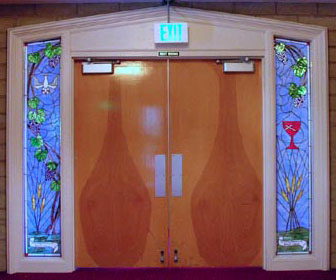
"The Eucharist"
I took up stained glass in January 2003 to create a panel for our bedroom, having found local artists unaffordable. In the process, I discovered that it is my ideal artistic medium: glass taps into my love of color and the play of light, my seamstress expertise in using fabric, and my comfort working with tools.
Although my drawing ability is generously described as "undeveloped", I had an idea for a home project and started to sketch. When my pencil failed me, I turned to my friend, the computer, and CorelDRAW. That helped, but I hoped there was something better. I found Glass Eye 2000, bought the basic version in April 2003, did the terrific tutorial (unusual for me), and signed up for the Yahoo discussion group. I not only learned about the software and stained glass techniques, I was able to contribute suggestions early on to people who were less comfortable with a computer.
I finished my first design in May that year using Glass Eye 2000, and have used it exclusively ever since. It has enabled me to develop my own designs instead of relying on others for patterns, resulting in a personal vision for our home. I especially appreciate the ability to trace photos: this alone is worth the price of the basic version! By photographing and tracing design elements, I can simplify the results and get an organic look along with a pattern that is workable and not need any drawing skills. Now I am usually armed with my digital camera, ready to take pictures of subjects that end up in my panels.
When my mother-in-law passed away in the spring of 2005, we learned that she wanted a stained glass window made for her church, Arlington Christian Church in Riverside, California, to complement the two she had done for her parents and deceased husband. While the estate committed to only one window, an interior door in the narthex had two sidelights that called out for replacement. The heirs (my adult step-children) asked for my help and I spoke to the minister, showing him a panel I had given my mother-in-law and a website of my other work. He was enthusiastic about my style and sketched out an idea he had to highlight the importance of communion to the denomination, showing a grapevine, wheat, and the red chalice with a St. Andrew's Cross, their symbol.
Armed with his drawing, we returned home to Mill Valley, near San Francisco, where I used Glass Eye 2000 to create a pair of panels. I was conscious of religious symbology in the design choices I made, which were enhanced as it evolved. The left panel evokes the Trinity in the three grapevines, three grape clusters and three wheat sheaves. The dove represents the descent of the Holy Spirit. The sweep of the vines from left panel to right links the Church Universal to the local congregation. The chalice of the Christian Church (Disciples of Christ) symbolizes the centrality of the Eucharist in Disciples' lives. The five wheat stalks have multiple meanings including being a mnemonic device. The stylized tendrils from the grape clusters represent how our beliefs are intertwined through our lives. In addition, the hills at the base reflected the shapes of elements in the other two panels my mother-in-law donated.
I upgraded my software to the Professional Edition, for its text support, ability to print selected sections of a design, and glass samples to facilitate communicating glass choices with the church, especially since they are 450 miles away.
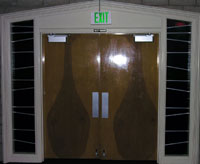
original door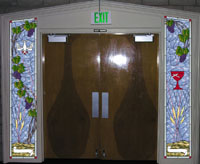
door with pattern overlayI exported two versions of my design, overlaid on a photo of the actual doors, and emailed them to the minister, who shared it with the congregation the following Sunday and replied with suggestions. I located grapevine photos on the web and got permission to use the dove and the chalice and refined my drawing. The next export was enthusiastically received, so I had full-sized colored printouts made and we drove back to Riverside for a presentation to the congregation and church's executive board.
I hung the printouts in place on Saturday, discovered that my measurements needed work, and tried again. The board chair is an art teacher with stained glass experience, and he made a design suggestion after I hung the printouts. Because I had transferred Glass Eye 2000 to my laptop, I was able to try out his ideas and show him the results when we met Sunday. The committee approved the design and asked me to produce it.
I thought my grape leaves needed "naturalizing", so we drove to nearby Napa Valley and I photographed grapevines up close. Loading these into Glass Eye 2000, I was able to improve the leaves and grape clusters, and printed out my pattern for fabrication. I cut the dedication pieces, printed the dedication section of the design, and found a local artist who painted the text on with paint that I fired in my home oven. I used a variety of purple globs for the grapes, which I formed and soldered together before cutting out the surrounding glass.
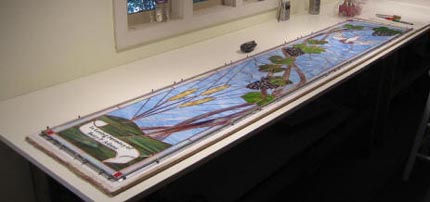
At 7 feet by 15 inches, the panels were challenge to transport in our sedan. Using ideas from the Dragonfly Software discussion group, we created a wood carton that just barely fit into our car with the back seat down and the front passenger seat all the way forward. I had barely 3 inches of leg room for the 7½ hour drive from Mill Valley to Riverside! We installed the panels in the church in September without difficulty and returned in November for the dedication. The church added track lighting behind the panels, which really makes them glow.
Having enhanced most of the windows in our house, I was pleased to have this opportunity for a commission. The experience working from the initial design stages through the formal proposal, acceptance, creation, and installation was invaluable.
~ Lynn Eichinger
About the artist
Lynn spent 10 years teaching and 20 years in the computer industry before discovering her affinity for stained glass a year after taking early retirement. She works out of a studio converted from a storage area under her home on a hillside in Mill Valley, California. Her husband, Jim Adams, provides assistance in design ideas, marketing, installing, crate building, chauffeuring, and "portering". Lynn's degrees are a B.A. in Psychology and a M.S.Ed in Special Education.
This pattern may be used to make one or more artworks for sale or personal enjoyment. This pattern may be printed for personal use only and may not be sold or given away in printed or electronic form.
Each month we feature a project designed using Glass Eye 2000. Do you have a project to share with the world? Contact Dragonfly Software and your creation might be our next Design of the Month.